
On October 31, 2025, the Ontario Ministry of Environment, Conservation and Parks (MECP) announced plans to create a provincial board-governed agency, the Ontario Provincial Conservation Agency, to provide leadership, governance, and strategic direction to Conservation Authorities (CAs).
An Amendment to the Conservation Authorities Act (CAA) to establish the Ontario Provincial Conservation Agency (OPCA) has been introduced. The agency will be responsible for:
- developing a single digital permitting platform,
- streamlining and standardizing service delivery by setting provincewide performance, standards as well as maintaining centralized data and updated floodplain mapping,
- overseeing the consolidation of Conservation Authorities.
The Ministry of Environment, Conservation and Parks is proposing that the agency would require Conservation Authorities to pay for the costs of the agency.
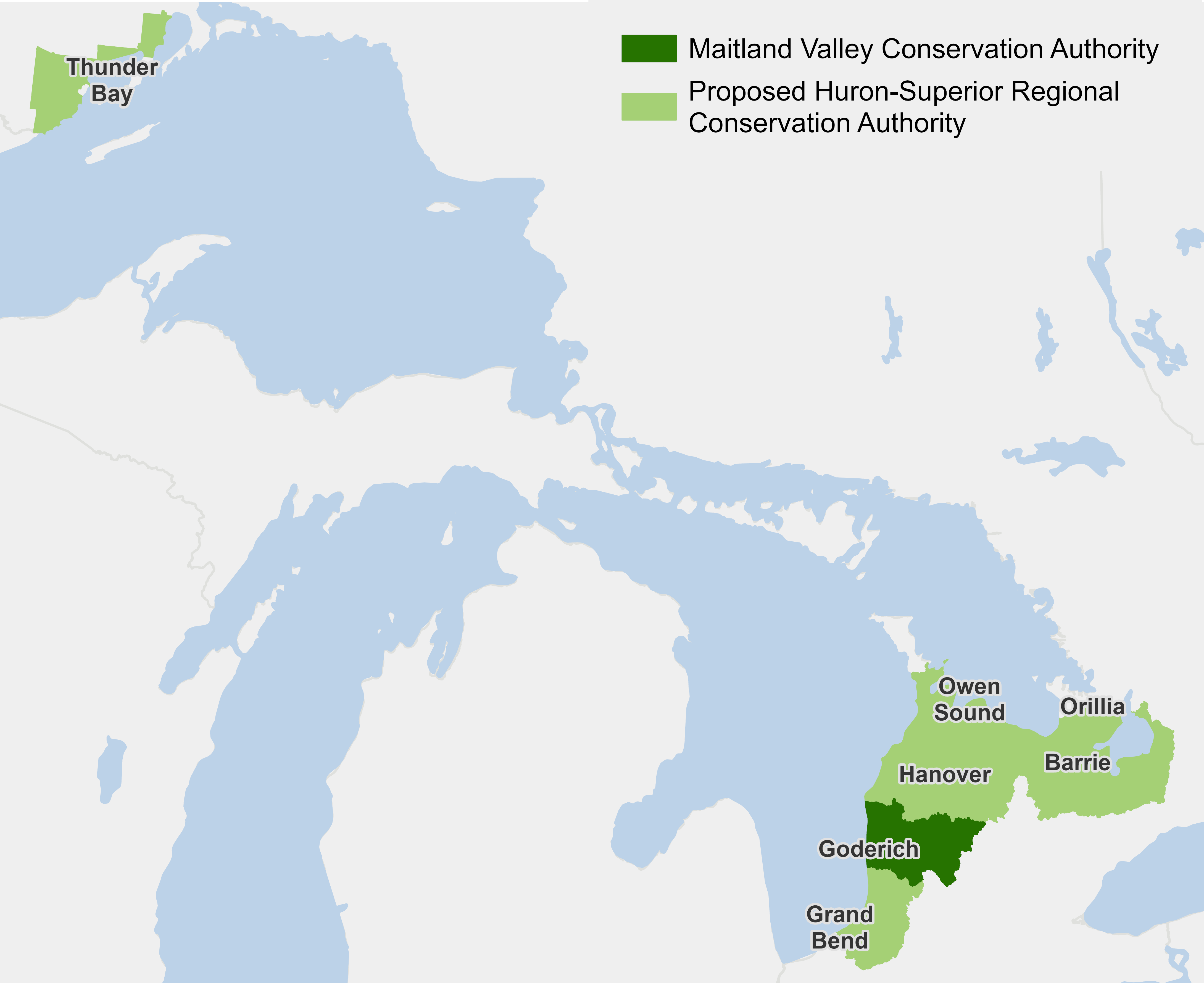
The MECP has introduced an amendment to the Conservation Authorities Act that outlines the proposed boundaries for establishing Regional Conservation Authorities. MECP plans to consult with stakeholders, municipalities, Conservation Authorities, and Indigenous communities. The proposed consolidation will entail reducing the number of Conservation Authorities from 36 to seven. The proposed consolidated areas can be viewed in the posted supplemented document or on the interactive map.
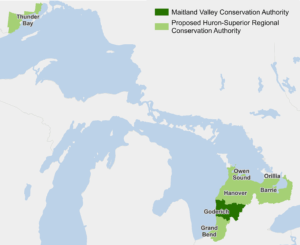
Proposed Huron-Superior Regional Conservation Authority
Consultation includes a policy proposal notice period posted on the Environmental Registry of Ontario for 45 days, inviting review and comments on criteria applied to determine proposed regional boundaries and the proposed geographical jurisdiction of each regional CA.
The deadline for comments is December 22nd.
The general timeline for the changes is expected to be:
- Consultation process – winter of 2026,
- Conservation Authorities operate with present governance until after the 2026 Municipal election,
- Implementation of changes – January 1, 2027.
Several concerns related to these proposed changes have been identified:
- What is the cost of establishing and operating the proposed Ontario Provincial Conservation Agency (OPCA)? The OPCA would require significant resources while local watershed advisory boards would still be needed to guide priorities and provide oversight.
- The province has not developed a business case to support the proposed changes. How do they know whether these changes will improve services and create efficiencies if they have not undertaken any analysis of the costs and the benefits?
- What is the cost of consolidation? Who will pay for these costs?
- As a local organization Maitland Conservation is responsive to community needs. Municipalities, landowners, and community partners drive the services and priorities of the organization. If the OPCA is going to provide strategic direction to Conservation Authorities, and Conservation Authorities are consolidated into seven regional Conservation Authorities, then this would mean less municipal input on service priorities.
- We are deeply concerned about whether the needs of rural communities and the agricultural sector will be adequately recognized and prioritized in this consolidation, particularly since the lead Conservation Authority is expected to be an urban one in each region.
- A core priority for Maitland Conservation is reducing the risk of loss of life and community damage caused by flooding and erosion. We are responsible for approving development in or near natural hazard areas, ensuring that new construction and additions are not at risk from flooding or erosion in floodplains or along the Lake Huron shoreline. Our permitting process is efficient and consistent – in 2024, the average time to process all types of permits was just 5.7 days. From start to finish, our staff work closely with landowners, emphasizing customer service and helping them identify safe building locations outside hazardous areas. Will the proposed digital permitting platform be able to match our turnaround times and maintain this high level of customer experience? Additionally, what will the costs be for developing and maintaining this platform? The average time for reviewing and issuing permits by all Conservation Authorities is 12.5 business days.
What’s Really Needed: A renewed relationship that is developed collaboratively focused on restoring healthy and resilient watersheds.
Conservation Authorities were founded on the principles of:
- watershed management,
- a partnership between the province and municipalities,
- a focus on local watershed priorities.
We would encourage the provincial government to work collaboratively with Conservation Authorities to build capacity and support local solutions to restore the health and resiliency of watersheds.
Member municipalities provide 80% of MVCA’s operating budget while the province provides 2%. Across all Conservation Authorities the province provides 5% of funding. A renewed partnership needs to include the province providing a greater share of funding as they did in the 1980’ and 1990’s.
To protect Ontario’s prosperity, we need to focus on developing and protecting the health of watersheds. They are the foundation of not only our economic prosperity but our life support system as well. Clean water, diverse forests and healthy soils directly support key sectors like tourism, forestry and agriculture, which in turn support economically strong communities.
We encourage the province to work collaboratively with Conservation Authorities and their member municipalities to determine how we can best achieve healthy, resilient and prosperous watersheds.
Healthy Lake Huron (HLH) is a model of collaboration between federal, provincial and county agencies, five Conservation Authorities and several community groups. HLH has been successful in supporting stewardship initiatives aimed at improving water quality along the Lake Huron shoreline. Using this collaborative approach across all the watersheds in Ontario to build healthy watersheds would result in effective, cost-efficient results.
Addressing issues at a watershed scale, ensuring representation for rural communities, and local governance overseeing priorities are critical for the protection of people, property and watershed health.
We encourage you to provide feedback to the proposed plans by December 22, 2025. Submit your comments to ca.office@ontario.ca or visit the Environmental Registry of Ontario site. Please consider passing your comments on to your local MPP and the Minister of Environment, Conservation and Parks.
Hon. Lisa M. Thompson
Huron – Bruce
lisa.thompsonco@pc.ola.org
Matthew Rae
Perth – Wellington
matthew.rae@pc.ola.org
Hon. Todd McCarthy, Minister of Environment, Conservation and Parks
todd.mccarthy@pc.ola.org
Questions? Please contact:
Phil Beard, General Manager – Secretary Treasurer
pbeard@mvca.on.ca
519-335-3557 ext. 231